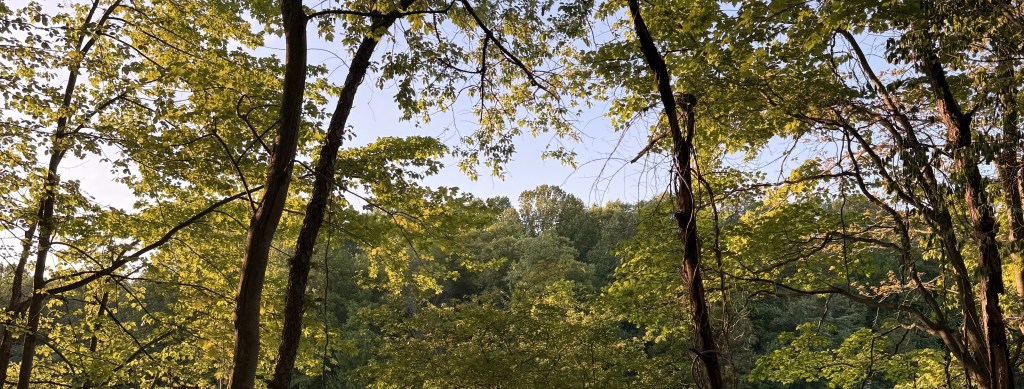
The summers repeat themselves.
I come home to a world that’s far greener than I’d left it. The cycle begins again: a new gym membership coupon code; switching out the cards in my wallet; the adjoining room a clothes-lair; cracking eggs into a pan. After a few promising weeks I lapse into something wordless, stagnant, uncreative. The summer daze. Then—mid-July: a roof, lifted. Or starting to. I reopen the dialogue with myself, put thoughts into words again. It comes more naturally than I think it will, but that doesn’t make it any easier to begin.
So it’s late July. I’m on speaking terms with myself again, but there are many conversations to be had (inside myself and otherwise) that I’m still putting off. Waiting for the nebulous “right time,” or maybe a twinge in my gut, or someone’s hands to shake my shoulders. I don’t know. And in some cases, I worry that seeing it through will be more painful than just.. never knowing how it ends. Where is the line between self-made closure and cowardice? That’s the thing:
What I thought was love
in me, I find a thousand instances as fear.
(That’s LeRoi Jones, in his 1963 poem “The Liar.” Just two years later, in 1965, he would change his name to Amiri Baraka. When I talk about his poems, I’m still unsure which name to say.)
When I stem the flow of words, it’s not out of peace; it’s avoidance. It’s an easy mistake to make, but not if you keep making it. And the tension really isn’t far beneath the surface. My summer daze is warm but unfriendly—the color of suspension, textured like muted worry. It’s pulling taut, waiting for the other shoe to drop. I’m reminded of Richard Siken’s “Boot Theory”…
And you can hear the man in the apartment above you
taking off his shoes.
You hear the first boot hit the floor and you’re looking up,
you’re waiting
because you thought it would follow [...]
but here we are in the weeds again,
here we are in the bowels of the thing: your world doesn’t make sense.
And then the second boot falls.
And then a third, a fourth, a fifth.
Suspended between the first and the second boot, “your world doesn’t make sense.” And then three more boots fall. Your world still makes no sense, just in the other direction. It’s weirdly reassuring.
By the way, this is how “Boot Theory” ends:
A man takes his sadness down to the river and throws it in the river
but then he’s still left
with the river. A man takes his sadness and throws it away
but then he’s still left with his hands.
When I’m thinking of Siken, though, I prefer to think of him through the soft, strange optimism of “Meanwhile” — which I have reproduced in full here, because I can; and italicized my favorite parts, because I can.
Driving, dogs barking, how you get used to it, how you make
                            the new streets yours.
Trees outside the window and a big band sound that makes you feel like
     everything's okay,
  a feeling that lasts for one song maybe,
                 the parentheses all clicking shut behind you.
          The way we move through time and space, or only time.
The way it's night for many miles, and then suddenly
                                     it's not, it's breakfast
   and you're standing in the shower for over an hour,
                   holding the bar of soap up to the light.
I will keep watch. I will water the yard.
      Knot the tie and go to work. Unknot the tie and go to sleep.
                            I sleep. I dream. I make up things
   that I would never say. I say them very quietly.
                      The trees in wind, the streetlights on,
          the click and flash of cigarettes
being smoked on the lawn, and just a little kiss before we say goodnight.
      It spins like a wheel inside you: green yellow, green blue,
                                  green beautiful green.
   It's simple: it isn't over, it's just begun. It's green. It's still green.
In sophomore year, I had a little print-out of “Meanwhile” taped to my wall. Green yellow, green blue, green beautiful green. It’s a beautiful poem because it’s a simple poem. It’s an infuriating poem because I wish I could’ve written it.
Time can occur on a sliding scale. Summer begins when I dispel the amber and start moving again. The end of July is the origin point. Isn’t it always? It isn’t over. It’s just begun.
The cycle of summer is an upward spiral, not a trap. I come home to a world that’s far greener than I’d left it. It’s green. It’s still green.
 zepploa blog